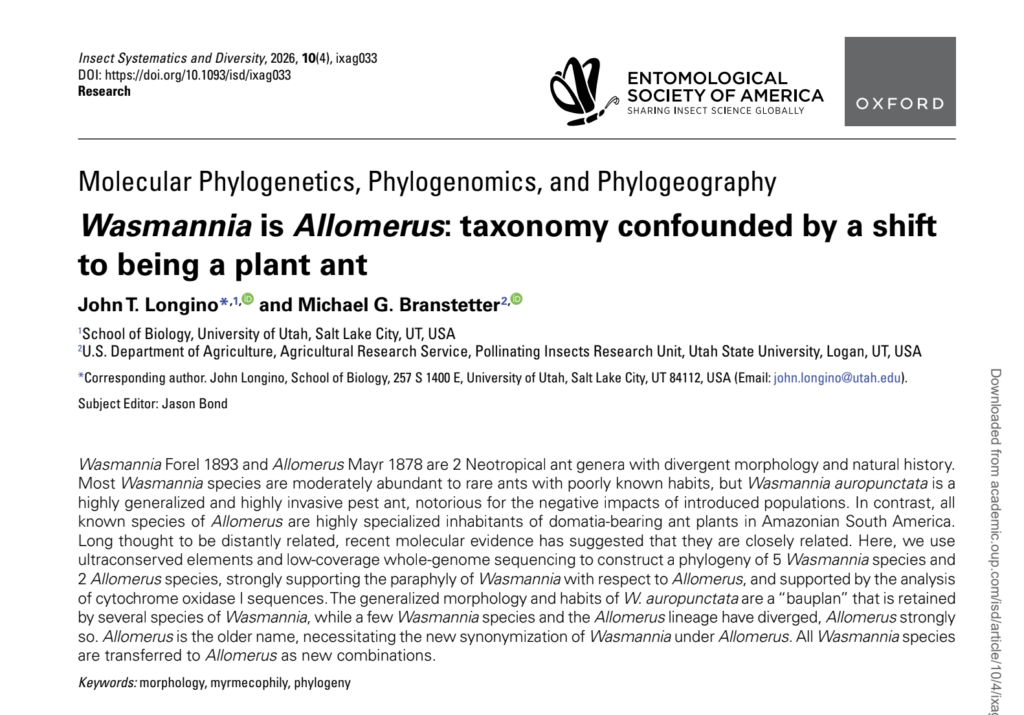
Recent research published in the journal of Insect Systematics and Diversity has determined
that Wasmannia auropunctata should actually be named Allomerus auropunctatus.
Many of us enjoy organizing and categorizing things, maybe you’ve moved and found the
process of putting things in “their place” cathartic or enjoyed doing a deep dive into your family’s
genealogy. A scientist who really enjoys this might become a taxonomist, a specialist in naming,
describing, and categorizing living things based on how they relate to one another. This helps
us understand a given organism’s place in the great tree of life. To do so, taxonomists use a
formal system of ranking ranging from broad “kingdoms” (animals, plants, and fungi are all
different kingdoms) to the more specific genus and species. An organism’s genus and species
make up its “binomial name” or “scientific name”. For example, if you’re reading this, you’re a
Homo sapiens, with Homo being your genus and sapiens being your species. Little Fire Ants
are no different, with their scientific name until recently being Wasmannia auropunctata. If
you’ve come to our extension events, that’s a name you may have heard before. There are
several Wasmannia species, all closely related to the auropunctata we’re so familiar with here in
Hawaiʻi.
If multiple species can be closely related to one another, then so can multiple genera. If two
species in the same genus are siblings, then you could think of two species in closely related
genera as cousins. Taxonomists thought Allomerus and Wasmannia, two genera of ants native
to the forests of South America, were not closely related at all due to their different
morphologies and natural histories until 2015, when molecular research found that the two
genera are very closely related. Think of it like submitting a DNA sample only to discover that
your fourth cousin twice-removed you’ve never even heard of is actually your cousin. Recent
genetics research from John Longino, at the University of Utah, and Michael Branstetter, at the
USDA Pollinating Insect Research Unit in Logan, Utah, discovered that actually, Allomerus ants
are nested within the Wasmannia family tree, and weren’t just a nearby branch. So they’re not
just cousins, they’re siblings and belong in the same genus.
In this sort of taxonomic situation, the older name takes precedence so Allomerus (first named
and described in 1878) takes priority over Wasmannia (first described in 1893). The alternative,
the paper explains, would be to name multiple new genera containing barely distinguishable
species. So, Wasmannia is now Allomerus and because many taxonomists are sticklers for
Latin and Greek grammar, the species name needs to change a little too. Say goodbye to
Wasmannia auropunctata and say hello to Allomerus auropunctatus!
What does this mean for you? Well, if you’re a homeowner, not much. They’re the same ants
and Tango™ still works wonders. If you’re a scientist or work with invasive ants, it’s important to
know about this news so that when you see the unfamiliar name Allomerus auropunctatus in
new scientific literature or in ant databases, you know that you’re reading about good old Little
Fire Ants.